The charger of the future is not floating magic. It is a small engineering bargain: send power through the air, but only to the right receiver, at the right angle, with strict safety limits. Infrared Charging Technology is now past the lab-demo stage for low-power devices, yet still far from replacing your iPhone cable on the kitchen counter. That is the honest answer. The best progress in the U.S. market is showing up around smart locks, sensors, small displays, toothbrush docks, and commercial IoT gear, where tiny amounts of steady power matter more than fast battery refill. For readers tracking consumer technology reporting, the story is not whether wireless power can travel across a room. It can. The harder question is whether it can do that cheaply, safely, and with enough device support to feel normal. Right now, infrared wireless charging works best when the device stays visible and does not move much. That sounds limited. It also explains why the first real wins are practical, quiet, and almost boring.
Where Infrared Charging Technology Stands Right Now
The present state is mixed in a way that should make you more interested, not less. Wireless power over distance has moved from “someday” to “installed in certain homes and businesses,” but the wins are narrow. That matters because narrow wins are how hardware earns trust before it earns hype.
Why smart locks became the first believable use case
A smart lock is almost perfect for infrared wireless charging. It sits in one place. It needs modest power. It annoys owners when batteries die. It also has a clear indoor line of sight from a hallway, ceiling, or wall-mounted transmitter.
That is why companies have aimed at door locks before phones. Alfred says its Wi-Charge-supported locks can receive safe infrared energy from a ceiling or wall transmitter, with an effective distance up to about 10 meters or 30 feet. The transmitter can also report charge level and health over Wi-Fi. That is not a dream sketch. That is a defined product pattern.
The non-obvious point is that a lock does not need “fast charging.” It needs “never forgotten charging.” A phone owner notices a cable. A lock owner notices failure only after standing outside with groceries. In that moment, a slow beam across a hallway beats a battery drawer every time.
Why phones are still the wrong target
Most people hear wireless power over distance and think about a phone charging in a pocket. That is the hardest version. Phones move, rotate, hide behind bodies, sit under blankets, and ask for far more power than a sensor or lock.
Infrared light wants a clear path. That path can be blocked by a person, a bag, a couch cushion, or the device’s own case design. A ceiling transmitter can aim at a receiver on a lock. It cannot easily feed a phone face-down under a pile of mail.
That is why the current progress should be judged by chores removed, not watts bragged about. If laser power transfer keeps a smart lock, retail shelf label, or low-power display alive for months without battery swaps, that is meaningful. It does not need to beat a USB-C cable to matter.
How Wireless Power Over Distance Actually Works
The cleanest way to understand this tech is to stop thinking of it as Wi-Fi for electricity. It is closer to a tiny invisible spotlight aimed at a small solar panel. The transmitter sends infrared light. The receiver converts that light back into electrical energy.
The beam must find the receiver first
A room-scale system needs a transmitter, a receiver, and control logic. The transmitter does not spray useful power across the whole room. It finds a matching receiver, aims energy toward it, and stops when the path is blocked.
Wi-Charge describes its AirCord system as using safe infrared light for smart locks, displays, and IoT devices at room-sized distances, including more than 30 feet in some deployments. The company’s own technology page says power is sent only to the target device rather than spread across the room.
That targeting is the whole point. It is also the trap. A beam that is narrow enough to be efficient also needs alignment. A beam that spreads everywhere wastes energy and raises safety questions. The practical design lives between those two problems.
Line of sight is a flaw and a safety feature
Line of sight sounds like a weakness because walls, people, and furniture can block it. For many devices, it is a weakness. A hidden water sensor under a sink may be a poor match unless the system has a clear angle.
Yet line of sight also keeps the energy honest. A beam that stops when interrupted gives engineers a direct way to manage exposure. The moment a person walks through the path, charging can pause. That is less dramatic than room-wide power, but it is easier to reason about in a home.
The best early systems treat the blockage as normal, not as failure. A lock can coast on its internal battery when someone walks past. A shelf label can miss a few seconds of charge. The receiver does not panic. It waits.
Safety, Regulation, and the U.S. Trust Problem
Americans will not accept invisible power beams at home unless the safety story is boring enough to survive daily life. That means labels, product classes, shutoff behavior, installation rules, and plain language. “Trust us” will not work here.
Why Class 1 laser language matters
The FDA recognizes laser hazard classes from I to IV, and higher classes carry more danger if misused. That makes classification central for any infrared product sold into homes, stores, or offices.
Wi-Charge states that its R1 transmitter is a Class 1 laser product and lists FDA, FCC, CE, IEC, and UL certifications on its safety page. The company compares the class to common devices like DVD players and barcode scanners.
Still, consumers do not live inside certification charts. They want to know what happens when a child waves a hand through the beam, when a dog crosses the hallway, or when a receiver is bumped out of place. Infrared wireless charging has to answer those ordinary questions before it can become ordinary itself.
The hidden hurdle is installation, not physics
The public debate often circles around whether the beam is safe. That is fair. But the home adoption hurdle may be more boring: where does the transmitter go?
A ceiling mount works better than a transmitter hidden behind a lamp. A lock receiver needs a clean view. Renters may not want hardware mounted above a door. Homeowners may not want another powered device on the wall.
That means adoption may start through builders, smart-home installers, hotels, offices, senior living sites, and retail locations. Those places can plan the beam path during installation. A random kitchen counter cannot.
The counterintuitive lesson is simple: this tech may become common in places where consumers do not install it themselves first.
Current Products, Cost, and Real Progress
The market has moved beyond concept videos, but it remains early. The best signal is not a flashy promise. It is the arrival of retrofit kits, smart-lock integrations, and year-long home tests that expose cost and daily behavior.
Smart-home tests show both promise and limits
A 2025 Verge test described a Wi-Charge-powered smart lock setup that kept the lock charged over a long period, but the full transmitter and installation cost was reported around $1,250. The same report said the system fit low-power devices best and noted energy efficiency around 15 percent.
That number should not scare serious readers away. Early hardware often looks expensive before integration shrinks the parts. The sharper concern is device support. One transmitter becomes more useful when it feeds several compatible products in the same room.
That is where laser power transfer needs an ecosystem. A smart lock alone is convenient. A lock, door sensor, wall display, and indoor camera receiver would feel like a platform. Until then, the value depends on one annoying problem being annoying enough.
Retrofit kits are a stronger sign than demos
In February 2026, Wi-Charge announced that the first batch of its Schlage Encode wireless power kit had sold out, with a second batch opened. The company described a 33-foot range, automatic beam steering, and a retrofit design for existing locks.
That matters more than a trade-show prototype. A retrofit kit admits how people buy home tech in the U.S. They do not want to replace every device because a new power idea arrived. They want one pain removed from something they already own.
The catch is that retrofit hardware can look awkward until it becomes native. The long-term win is not a kit clipped onto a known product. It is a lock, sensor, or display designed around the receiver from day one.
Conclusion
The cleanest forecast is also the least flashy: infrared wireless charging will spread first where devices are fixed, visible, low-power, and painful to maintain. That means smart locks, sensors, retail labels, small displays, and building systems before phones, laptops, or kitchen appliances.
The next few years will decide whether Infrared Charging Technology becomes a quiet smart-home layer or stays a specialty answer for a few premium products. The physics works well enough for selected jobs. The market now has to solve cost, installation, device support, and consumer comfort.
That is not failure. It is the normal road for hardware that touches safety, power, and daily habits. The winners will not sell “power through the air” as a stunt. They will sell one less dead battery, one less service call, and one less small failure at the worst time. Start there, and the future looks much closer.
Frequently Asked Questions
How far can infrared wireless charging work inside a home?
Current consumer-facing systems commonly talk about room-scale reach, often around 30 feet when the receiver has line of sight. Real performance depends on transmitter placement, receiver size, beam angle, and whether people or objects block the path during use.
Is infrared wireless charging safe around children and pets?
Certified products are designed to meet laser safety rules and pause power when the beam path is interrupted. Buyers should still look for clear Class 1 laser labeling, recognized safety certifications, and installation guidance from the manufacturer before placing hardware in a home.
Can wireless power over distance charge a phone?
It can in theory, but phones are not the best early target. They move often, need more power, and are often blocked by hands, pockets, cases, or furniture. Low-power fixed devices are a better match for today’s systems.
What devices are best for infrared wireless charging?
The best matches are devices that stay in one spot and need small amounts of steady power. Smart locks, sensors, electronic shelf labels, toothbrush docks, small displays, and IoT hardware fit better than laptops, tablets, or gaming devices.
Does laser power transfer work through walls?
No, not in the normal sense. Infrared light needs a clear path between transmitter and receiver. A wall, person, cabinet, curtain, or other solid object can block the beam and pause charging until the path is clear again.
Why is line of sight required for infrared wireless charging?
Infrared systems send energy as a focused light beam. That focus helps direct power to the receiver instead of spreading it across the room. The same focus also means the system needs a visible path to keep charging.
Is infrared wireless charging better than Qi wireless charging?
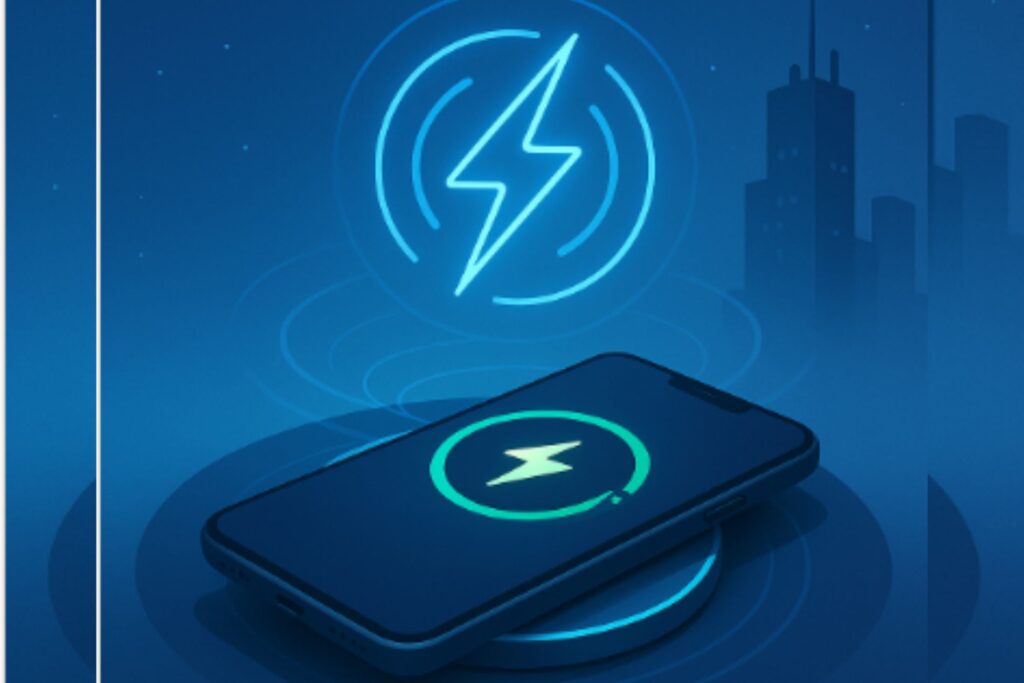
It solves a different problem. Qi is useful for phones and earbuds placed on a pad. Infrared systems aim to power devices across a room. Qi is easier today. Infrared power is more interesting for fixed devices you hate maintaining.
When will long-range wireless charging become common in U.S. homes?
It will likely grow through smart locks and installed smart-home gear before it becomes common for personal electronics. Wider adoption depends on lower costs, more built-in receivers, simpler installation, and enough compatible devices to make one transmitter worth buying.